 Product case studyEmail outreach
Building MailTig: Cold Email With Guardrails and Open Pricing
We profiled eleven outreach and email platforms, traced where buyers lose money and sender reputation, and built a workspace that sends only from mailboxes customers control and publishes every price.
- Platforms profiled
- 11
- Mailbox providers supported
- 6
- API operations swept, 0 exposed
- 343
- Version 1.0 released
- Nov 2026
The case in three lines
The problem
Outbound teams pay for cold email three ways: the plan price, the add-ons that appear after signing up, and sender reputation they cannot see draining. Since 2024, Google, Yahoo, and Microsoft have also raised the bar every sender must clear before the first email goes out.
Our approach
We studied 11 platforms feature by feature and price by price, then built MailTig on four rules: send only from mailboxes the customer controls, check setup before any campaign starts, never let AI email a prospect on its own, and publish every number.
What it changes
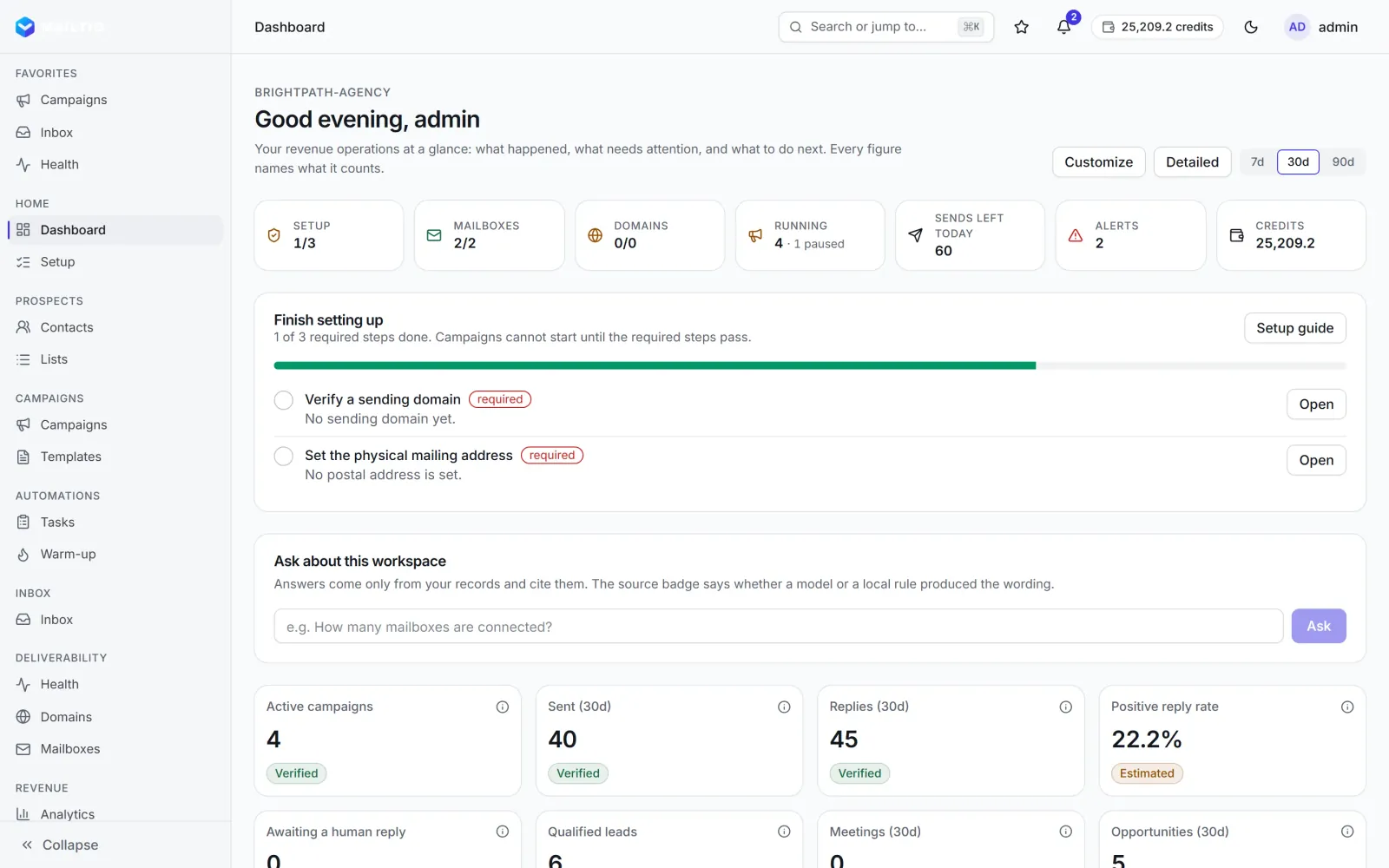
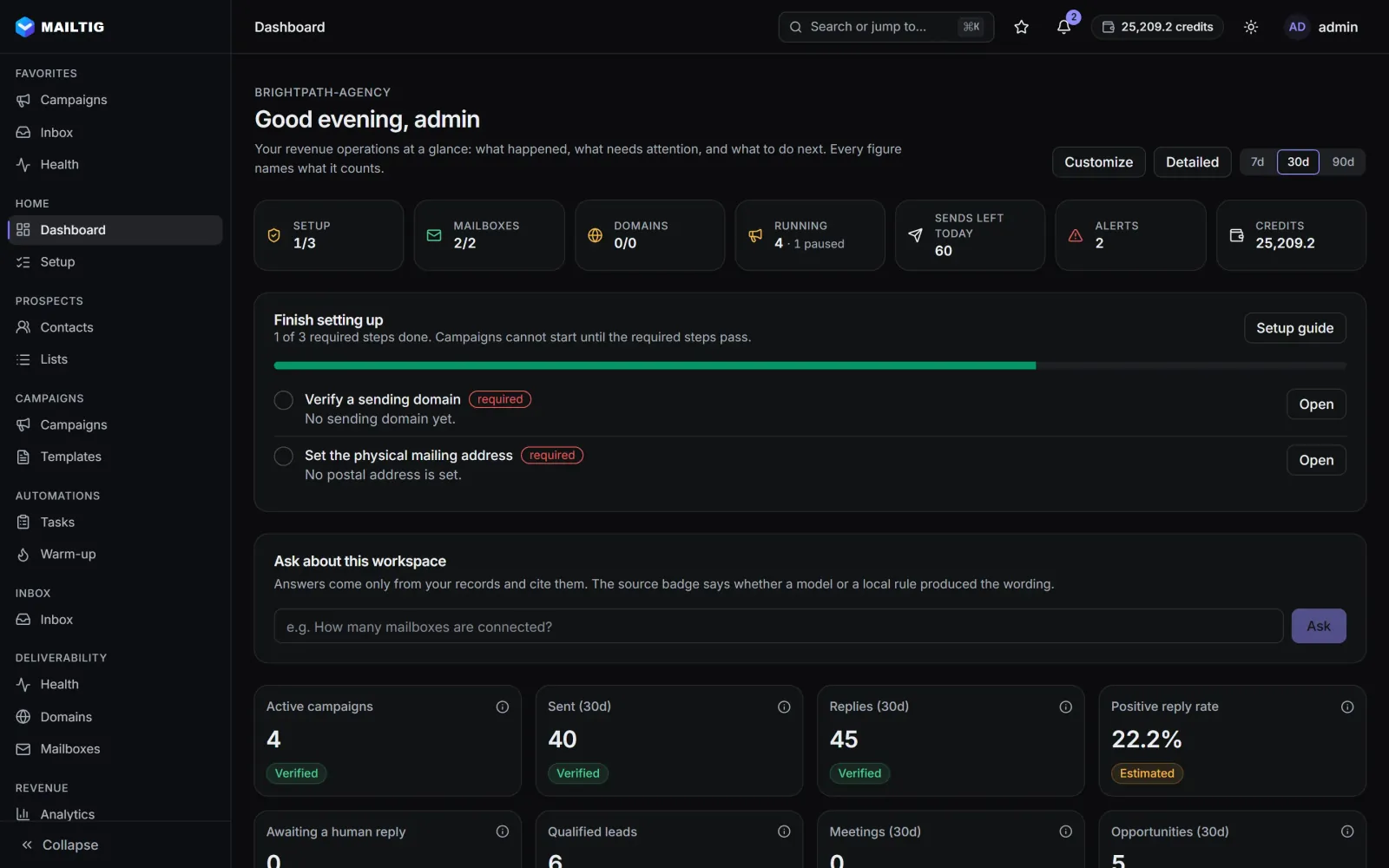
MailTig 1.0 shipped on November 4, 2026, with preflight checks, send-time suppression, a bounce breaker, a unified inbox, and a public price list with no add-ons. The next gates are commercial: usability sessions, paid pilots, and a cost model built from real usage.
Protecting the sender's reputation is the product. Every guardrail in MailTig exists so that one bad list never costs a team its domain.
What we studied before writing code
MailTig started as a teardown of ManyReach, a credit-metered cold email platform whose model was closest to what we wanted to build: one credit per campaign email, 250 free credits, and no seat fees. We documented every capability it offered, ranked each one from P0 (must ship in the first release) to P3 (later), and mapped it onto the ABP Framework and React architecture we planned to use. We also read what its users said on G2, Reddit, and review sites. They praised unlimited mailboxes and automated follow-ups, and they complained about a rough interface, thin documentation, support replies that took days, and pricing they found complicated. That list became the first draft of our requirements.
In October 2026, with the core product built, we widened the study to 11 platforms in three groups: cold email sequencers (ManyReach, Instantly, Smartlead, Lemlist, Reply.io, Woodpecker, and Snov.io), a data-first sales platform (Apollo), and three email platforms that cold senders often try first (Brevo, MailerLite, and Mailtrap). We fetched pricing pages, help centers, API references, and changelogs on October 15, 2026, compared every platform across ten capability areas, and scored MailTig from its code rather than its marketing. Where a vendor's own page was unavailable, we used dated third-party sources and labeled them as such.
We also read the rules every sender now works under. Google and Yahoo began enforcing bulk-sender requirements in February 2024, and Microsoft followed for Outlook.com on May 5, 2025: SPF and DKIM with an aligned DMARC record, one-click unsubscribe honored within two days, and spam complaints kept under 0.3%. Those rules turned several optional features into requirements, and they shaped the guardrails we built.
From that evidence we built our buyer personas: founders running their own outbound, sales teams working several mailboxes, and agencies managing many clients. They are drawn from public reviews and competitor documentation, with secondhand evidence labeled as such. The next phase of research is first-hand: structured buyer interviews, moderated usability sessions, and paid pilots.
- 01Feature teardown of ManyReach, with every capability ranked P0 to P3 and mapped to our architecture
- 02Pricing, plan, help-center, and API pages for 11 platforms, fetched October 15, 2026
- 03A ten-area capability matrix, from mailboxes and warm-up to agency tooling, billing, and compliance
- 04Public reviews on G2, Trustpilot, Capterra, and Reddit, flagged wherever they came secondhand
- 05Sender requirements published by Google, Yahoo, and Microsoft
- 06A market baseline sorting features into table stakes, differentiators, and emerging items
What customers were struggling with
Setup decides deliverability before the first send
Google and Yahoo now require bulk senders to pass SPF and DKIM with an aligned DMARC record and to support one-click unsubscribe, and Microsoft began enforcing similar rules for Outlook.com on May 5, 2025. Each record has its own traps: an SPF record that needs more than 10 DNS lookups fails even when its syntax is correct. In our persona research, domain and mailbox setup was the main obstacle for solo founders starting outbound.
Reputation drains without explanation
Shared warm-up pools are the category default, and users report open rates falling 30 to 40% after their mailboxes joined one (secondhand reports, relayed by competing vendors). Reviews of the volume leaders describe silent warm-up pauses, stuck sending queues, and mailboxes that disconnect without warning. When reputation slips, the sender rarely sees why.
The plan price is not the price
Reviewers estimate the cost of a working cold email stack at two to three times the plan price once mailboxes, domains, and data are added. Client workspaces, placement tests, LinkedIn seats, and even API access are sold separately at several vendors, and some credit systems expire unused balances every period.
Replies arrive in too many places
A sales rep working several mailboxes switches between inboxes and the CRM to keep context on each prospect. At Instantly, replying from the unified inbox was gated to Hypergrowth and above on its October 2026 plan table, so entry-tier users could read replies there but not answer them.
Agencies pay per client to keep clients apart
An agency needs each client's mailboxes, contacts, and reporting kept separate. When we checked, Smartlead charged $29 per client workspace per month, Woodpecker $27 per active client for its agency panel, and ManyReach $29 to $199 a month for whitelabel, so the cost of separation rises with every client signed.
Support and documentation lag the product
Our first study found ManyReach users praising its volume while describing a rough interface, thin documentation, and support replies that took days. Across the category, Trustpilot reviews repeat the pattern: slow tickets, campaigns that stop without a clear reason, and billing that continues after cancellation.
Where existing tools fall short
The calls we made, and what they cost
- 01
Warm-up stays inside the customer's own mailboxes
Our competitor report recommended a shared warm-up network across tenants, because every major competitor runs one. We decided against it. MailTig's warm-up exchanges messages only between a workspace's own connected mailboxes, needs at least two of them, ramps on a fixed plan, and pauses itself when recent failures pass 5%. A shared pool ties each sender's reputation to every other mailbox in it, and users of shared pools report drops they could not explain; keeping warm-up inside the customer's own mailboxes keeps cause and effect visible. The cost is real: warm-up scales more slowly, a workspace needs two mailboxes to start, and we meter it at 0.1 credit per message where most rivals include it free.
- 02
Every send is recorded before it leaves
In an early version, a crash between a provider accepting an email and our database recording it would have resent the message once the lease expired: a duplicate email to a prospect and a double charge. We reversed the order. The dispatcher now commits a dispatching record and the credit debit, keyed to the message, before it calls the provider. A connection error means the provider never received the message, so the credit is refunded and the send retried later. A timeout, where the provider may have accepted it, is marked unknown and never retried automatically. The trade-off is one extra database write per send and an operator view for the rare unknown outcome.
- 03
One modular monolith with strict tenant boundaries
MailTig is a single .NET 10 application on the ABP Framework: the API and its Hangfire background workers ship as one deployable, backed by PostgreSQL and Redis, and scale horizontally. Every table carries a tenant id, every background job switches tenant per item, and inbound webhooks resolve the tenant only after their signature or secret is verified. We rejected microservices and a database per tenant for now, because no scale evidence justified their cost. The price is a shared failure domain, and tenant isolation rests on automated cross-tenant tests rather than separate databases. It is the rule we apply on custom software projects: extract a service only when telemetry proves the need.
- 04
AI drafts, people send
AI in MailTig is off until a workspace connects its own OpenAI-compatible endpoint and key. Every model call passes through one gateway with a kill switch, a monthly call budget, versioned prompts, output validation, and an audit row that stores a hash of the input rather than the text itself. Reply drafts are marked approved only when a person presses Send, and every AI feature has a rules-based fallback. We gave up autonomous AI sales agents, which the market prices at $500 to $3,000 a month, in exchange for a product that never emails a prospect on its own. It is the pattern we use in AI and data engineering work for clients: the model proposes, a person approves.
- 05
Email is the only channel we send on
Lemlist and Reply.io automate LinkedIn, calls, and SMS, and buyers increasingly expect multichannel sequences. We chose not to automate LinkedIn browser actions that violate the provider's terms, and we kept SMS, calls, and WhatsApp manual as well. LinkedIn, SMS, call, and WhatsApp steps in a MailTig sequence create a task for a person, and completing or skipping the task moves the sequence on. We trail the multichannel suites on automation as a result. In exchange, every message MailTig sends goes through a mailbox and a provider the customer controls.
From pain point to product
Setup mistakes that surface only after a campaign bounces
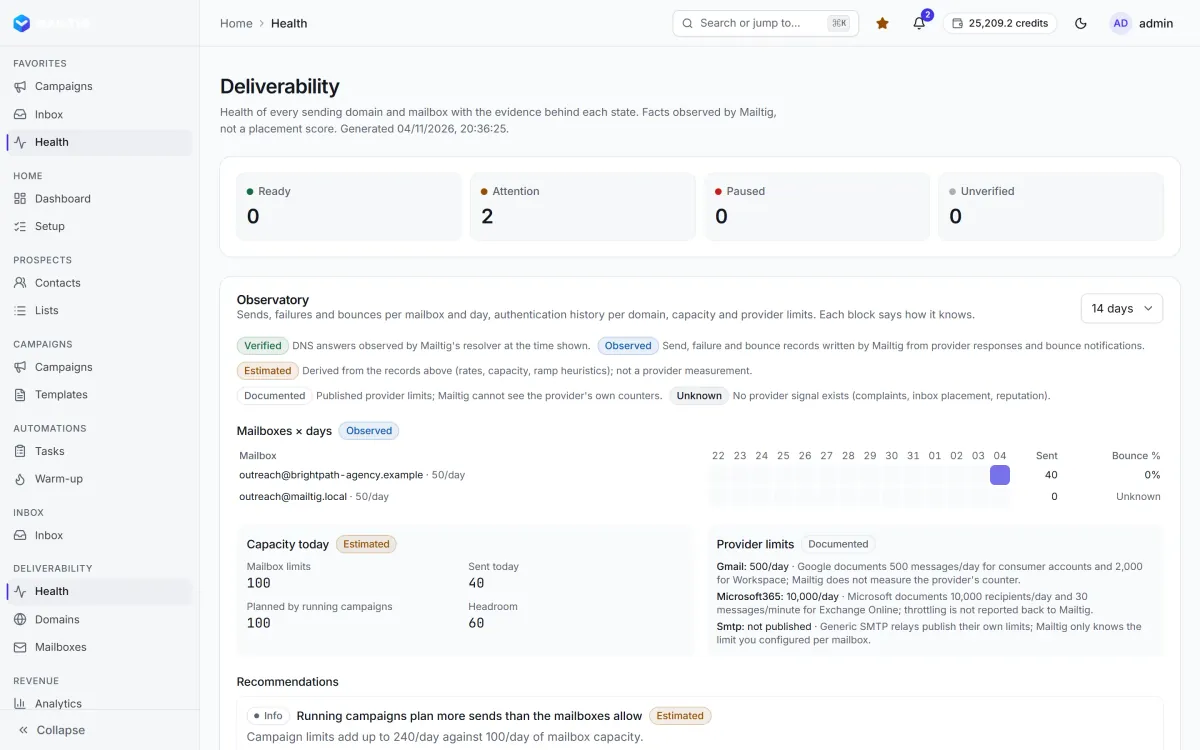
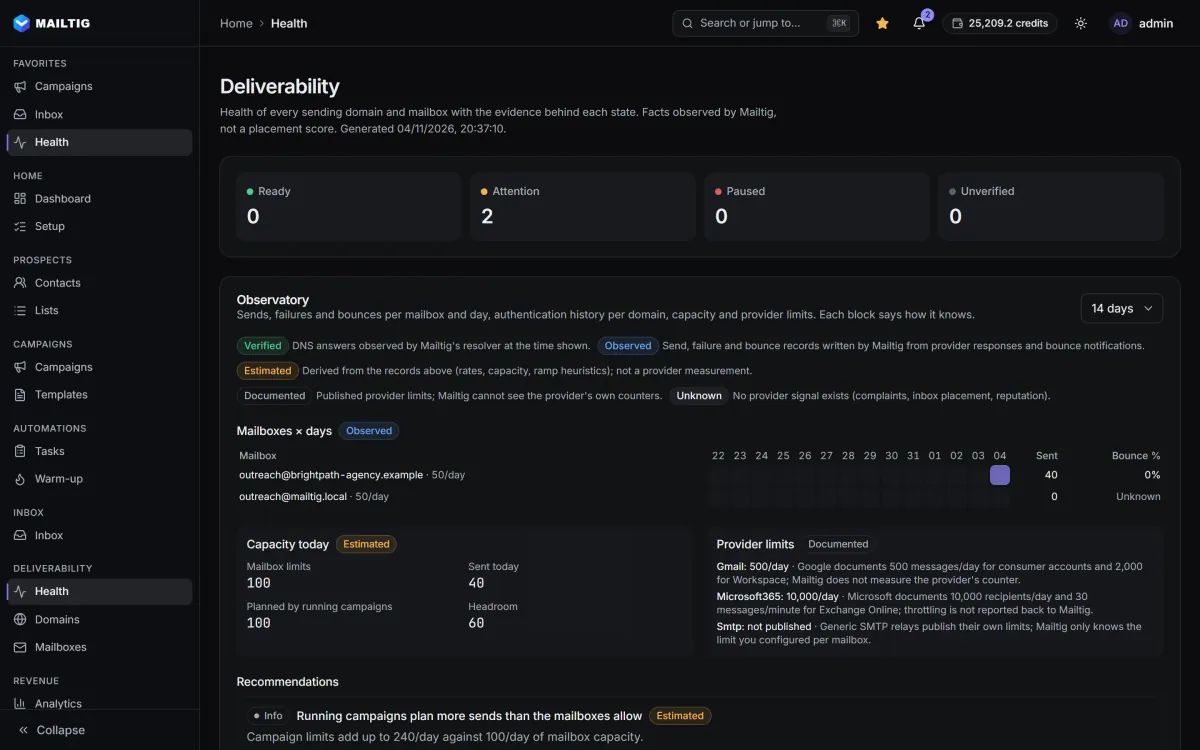
SPF, DKIM, and DMARC records generated per sending domain and checked by DNS lookup hourly until they pass, a setup checklist with the exact remedy for each step, and a preflight that blocks a campaign while blockers remain.
Reputation damage nobody explains
A daily limit on each mailbox (50 by default for personal mailboxes), rotation across a mailbox pool, own-mailbox warm-up with an automatic pause, and a breaker that stops a campaign at a 5% bounce rate after 20 sends and shows the reason.
Opt-outs that slip through a queue
Contact status and the workspace blocklist rechecked immediately before every send, with one-click List-Unsubscribe headers and a postal-address footer on each message.
Duplicate or double-charged sends
A send state machine that records the attempt before the provider call, refunds failed sends against the same message, and never auto-retries an unknown outcome.
Replies scattered across mailboxes
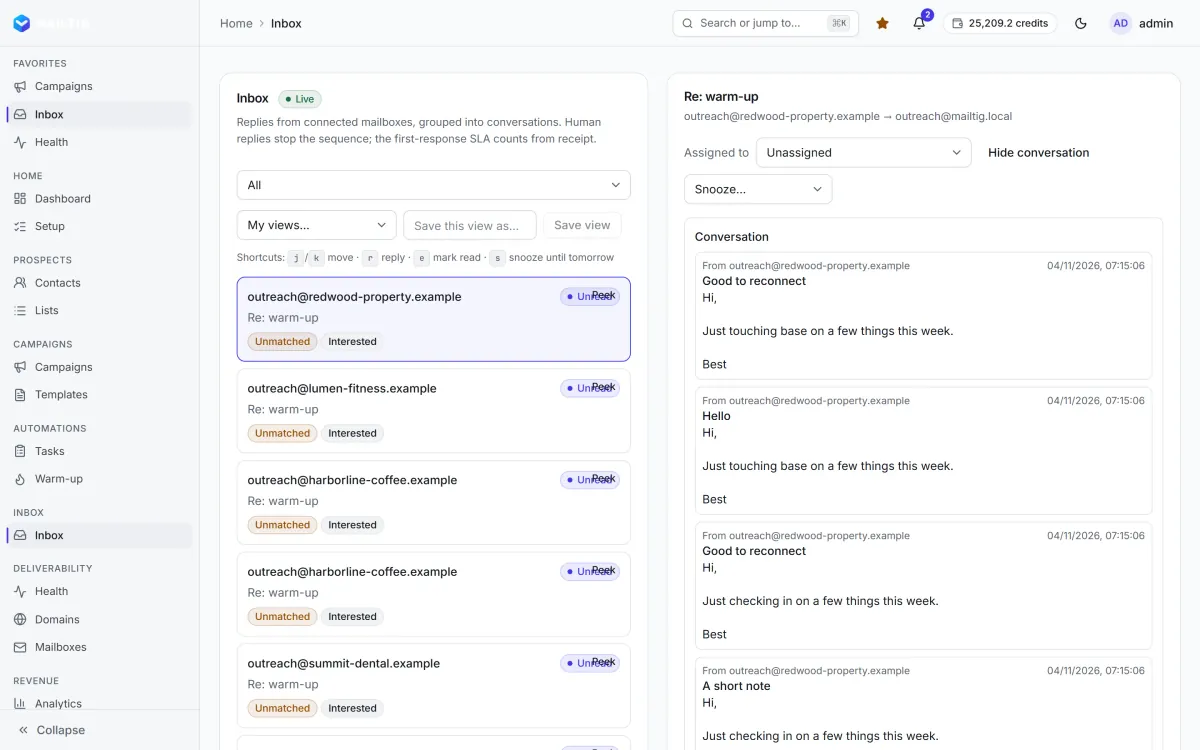
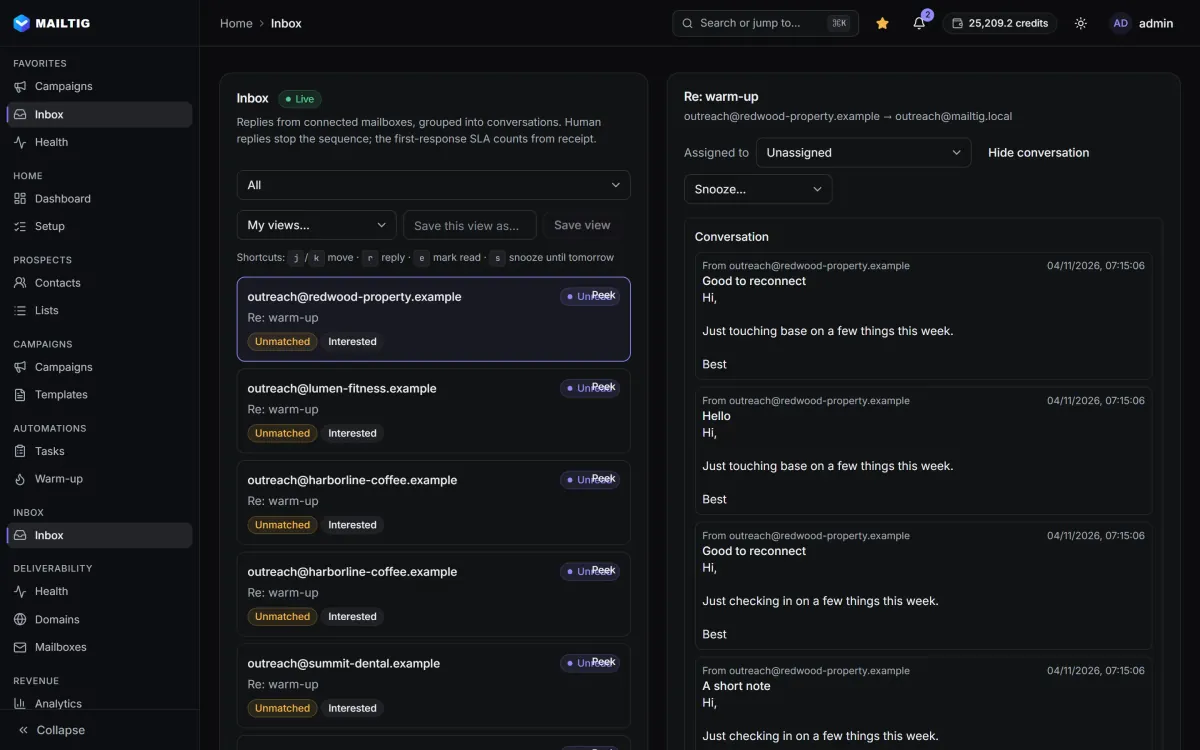
One inbox across every connected mailbox, with replies matched by message headers, bounces and auto-replies detected, sentiment classified, assignment, snooze, and notes, and a human reply that stops the sequence.
Costs that appear after signing up
A published catalog with no add-ons or overage, credits that never expire, and a credit forecast and cost-per-reply view inside the workspace.
Agencies paying per client for separation
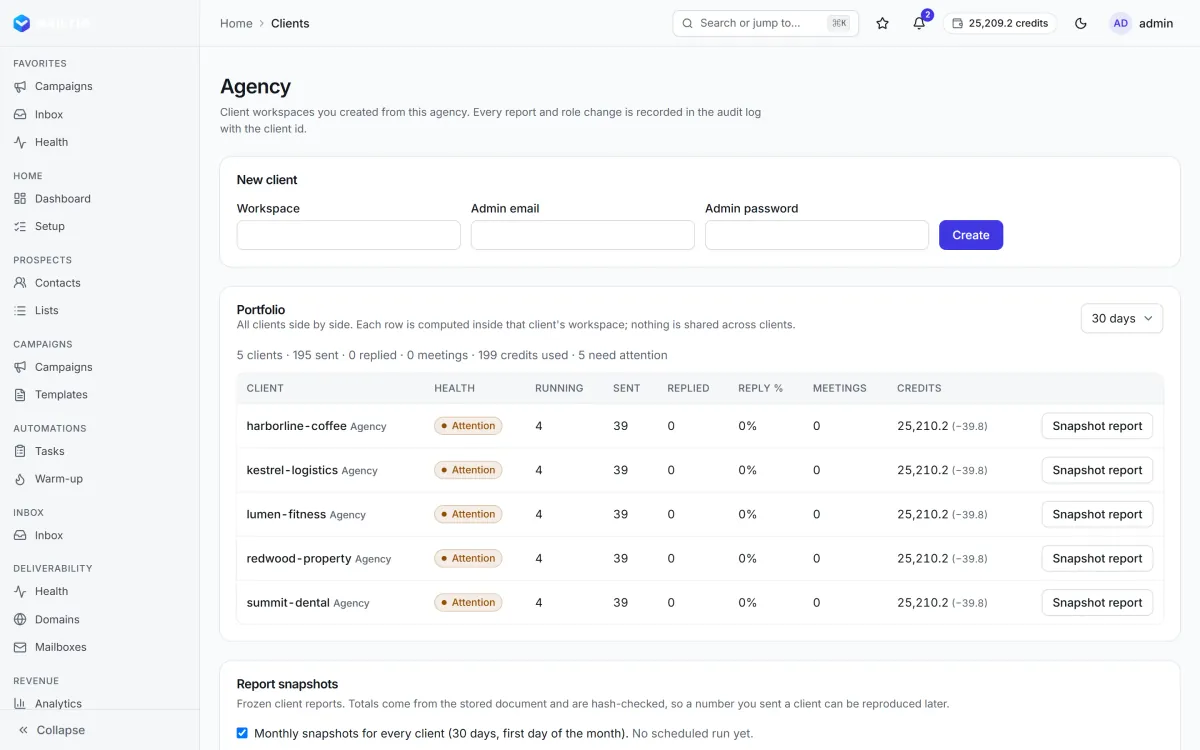
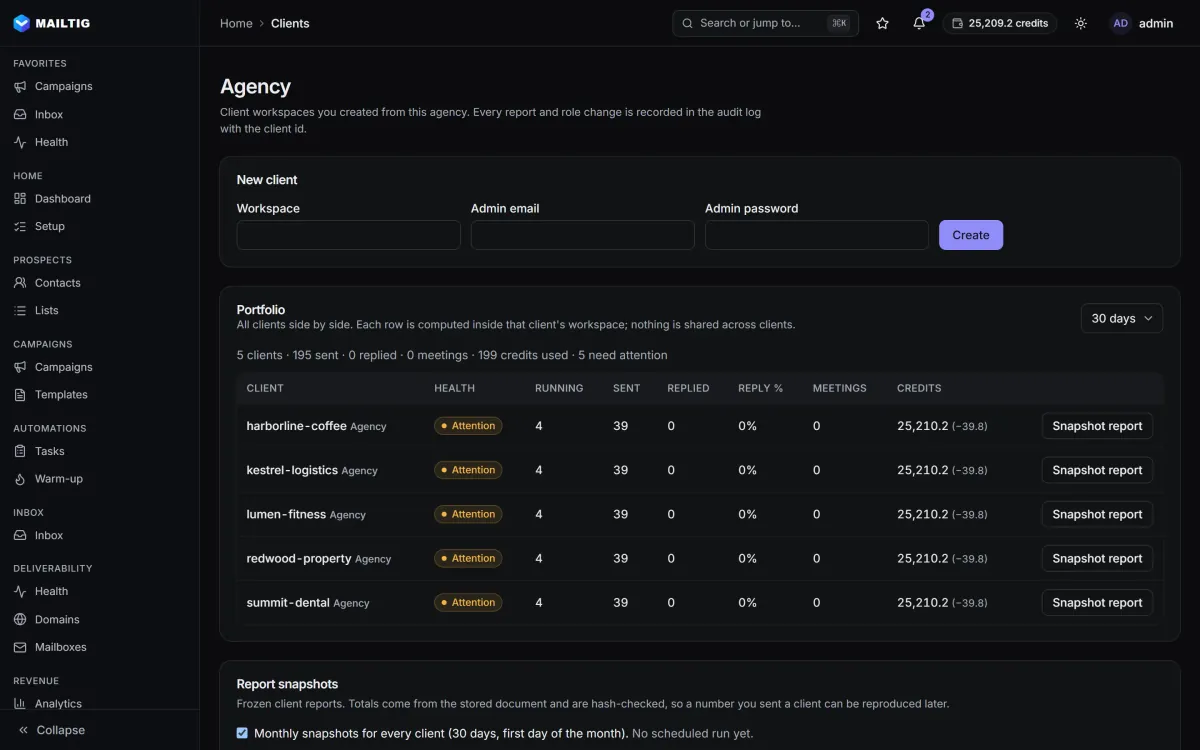
An Agency plan with separate client workspaces, role templates, a portfolio view, monthly report snapshots, and whitelabel branding included in one price.
Integrations that fail without a trace
Twelve signed webhook events with retries and a delivery log, contact and reply pushes to four CRMs, Zapier and Make apps, and a REST API with scoped keys.
Inside MailTig
How it makes money, and who it serves
MailTig charges for usage, not seats. A campaign email costs one credit, an address verification or warm-up message 0.1, and an enrichment match from a paid provider 0.5. The Free plan costs $0 and includes 250 trial credits and five mailboxes. Business is $79 a month with 5,000 credits and up to 50 mailboxes; Agency is $299 a month with 25,000 credits, up to 500 mailboxes, client workspaces, and whitelabel branding. Packs from 500 credits for $19 to 50,000 for $799 top up any plan. Credits never expire, failed sends are refunded, and there is no overage charge, annual discount, or add-on.
We sell software, not infrastructure. MailTig does not resell contact data, mailboxes, shared warm-up, or private IPs. Customers pay those providers directly, and the pricing page lists the external costs (mailbox subscriptions, ESP usage, domains, verification, enrichment, and AI model usage) so nothing appears later. AI runs on the customer's own model key, which keeps model cost off our books and leaves the choice of provider with the customer. Bundling client workspaces and whitelabel into one Agency price targets the per-client fees agencies pay elsewhere, $27 to $29 per client at the vendors we profiled.
MailTig is deliberately not priced to win on raw volume. Volume-first tools bundle six-figure monthly send allowances at similar prices; MailTig is priced for teams that want guardrails on every send (preflight, send-time suppression, and a bounce breaker) and one inbox for every reply, at about 1.6 cents per campaign email on Business. A high-volume tier will follow only when a cost model built from real hosting, provider, and support invoices shows our margin at 10,000, 100,000, and one million sends a month, so growth in volume never outruns the economics.
Any repricing has a written checklist: a completed cost model, a reconciled credit ledger, anti-abuse controls for any larger free allowance, an explicit decision on warm-up metering, and price points tested in buyer calls and paid pilots. Until those are met, the published catalog stands exactly as it is.
Founders
A first campaign that cannot start broken. Connect one mailbox, publish the DNS records MailTig generates, and preflight shows exactly what still blocks a send. The Free plan's 250 trial credits cover a small pilot before any purchase.
Sales teams
Every reply from every mailbox in one inbox, matched to its campaign and contact, with a human reply stopping the sequence. Conversations can be assigned, snoozed, and annotated, reply alerts reach Slack or Microsoft Teams, and new contacts and reply notes flow to HubSpot, Pipedrive, Salesforce, or Zoho.
Agencies
Separate client workspaces, role templates, a portfolio view, and monthly report snapshots, all under the agency's own name, logo, and domain, for one Agency price instead of a fee per client.
RevOps and developers
A REST API with an OpenAPI description, scoped API keys, and TypeScript SDK definitions, 12 signed webhook events with retries, and Zapier and Make apps. Rate limits are published per plan: 60, 600, or 3,000 requests a minute.
Finance and buyers
A bill that can be calculated before signing: published plans and packs, credits that never expire, refunds on failed sends, no overage, and monthly statements that reconcile with the credit ledger.
Status today, and what comes next
MailTig is live. Version 1.0 was released on November 4, 2026, and anyone can create a workspace at mailtig.com, start on the Free plan, connect mailboxes they control, and buy credits or a plan at the published prices. It is offered worldwide, with RNDSOL as the contracting party.
The release passed 338 backend tests and a 137-test browser suite (129 passed, 8 skipped because their test data was absent, none failed). An anonymous sweep of all 343 API operations found none exposed, and a cross-tenant probe was denied on every attempt. These are our own automated checks, not an independent audit.
The next stage is outside validation. An independent penetration test and formal security certification are on the roadmap, alongside moderated usability sessions and paid pilots. Deliverability and customer results will come from production workspaces, and we will publish them once they can be measured properly rather than estimated.
Next on the roadmap
- Buyer interviews, moderated usability sessions, and paid pilots, the gates we set before any pricing change
- A cost model built from real invoices and ledger data, before any high-volume tier
- A read-only MCP server so AI assistants can query a workspace (in progress)
- Inbound CRM sync and field mapping, so CRM updates flow back into MailTig
- Inbox placement testing through a partner
- An independent penetration test
- Interface translation beyond English
- .NET 10
- ABP Framework
- PostgreSQL 17
- Redis
- Hangfire
- OpenIddict
- MailKit
- React 19
- TypeScript
- Tailwind CSS
- OpenTelemetry
- Docker
See MailTig for yourself
MailTig is cold email software: conditional sequences from your own Gmail, Microsoft 365, or SMTP mailboxes, a unified inbox, and published credit pricing.

Related reading
Email Warmup Explained: Timelines and Safe Volumes
Email warmup raises a new mailbox's volume over three to six weeks. It builds history but cannot fix bad lists, failing SPF, DKIM or DMARC, or complaints.
Cold Email Deliverability: A Pre-Send Checklist
Google, Yahoo, and Microsoft now set the floor for cold email. A pre-send checklist for DNS records, unsubscribe headers, mailbox limits, bounces, and warm-up.
How to Choose Cold Email Software: A Buyer's Guide
Most cold email tools now ship the same core features. What separates them is the pricing model, gated tiers, warm-up approach, and support. A buyer's guide.
Cold Email Tools in 2026: What Is Now Table Stakes
Cold email tools converged on one feature bundle. Competition moved to infrastructure, data, AI agents, channels, and agency pricing. What our research found.