 Product case studyWhatsApp connectivity
Building WhatsTig, the WhatsApp Layer We Needed First
WhatsTig started as the WhatsApp layer for two of our own products, EduTig and MailTig. This is the research behind it, the trade-offs we accepted (platform risk included), and the decisions that made it a product of its own.
- Products on one connection
- 6
- RNDSOL products it was built for
- 2
- API releases, 1.0 to 1.4
- 5
- Architecture decisions on record
- 19
The case in three lines
The problem
EduTig and MailTig needed WhatsApp: parents in Pakistan read it far more reliably than email, and outreach users wanted WhatsApp steps in their sequences. The official route asks for business verification, a dedicated number, approved templates, and per-message fees before the first message, and the unofficial tools we reviewed left multi-tenancy, retry safety, and consent to the integrator.
Our approach
We built one multi-tenant platform that holds each WhatsApp session encrypted and exposes it twice: a documented API with signed webhooks for software, and a dashboard for teams. We stated the unofficial protocol plainly from day one and built consent, conservative pacing, and truthful delivery states into the core instead of leaving them to settings.
What it changes
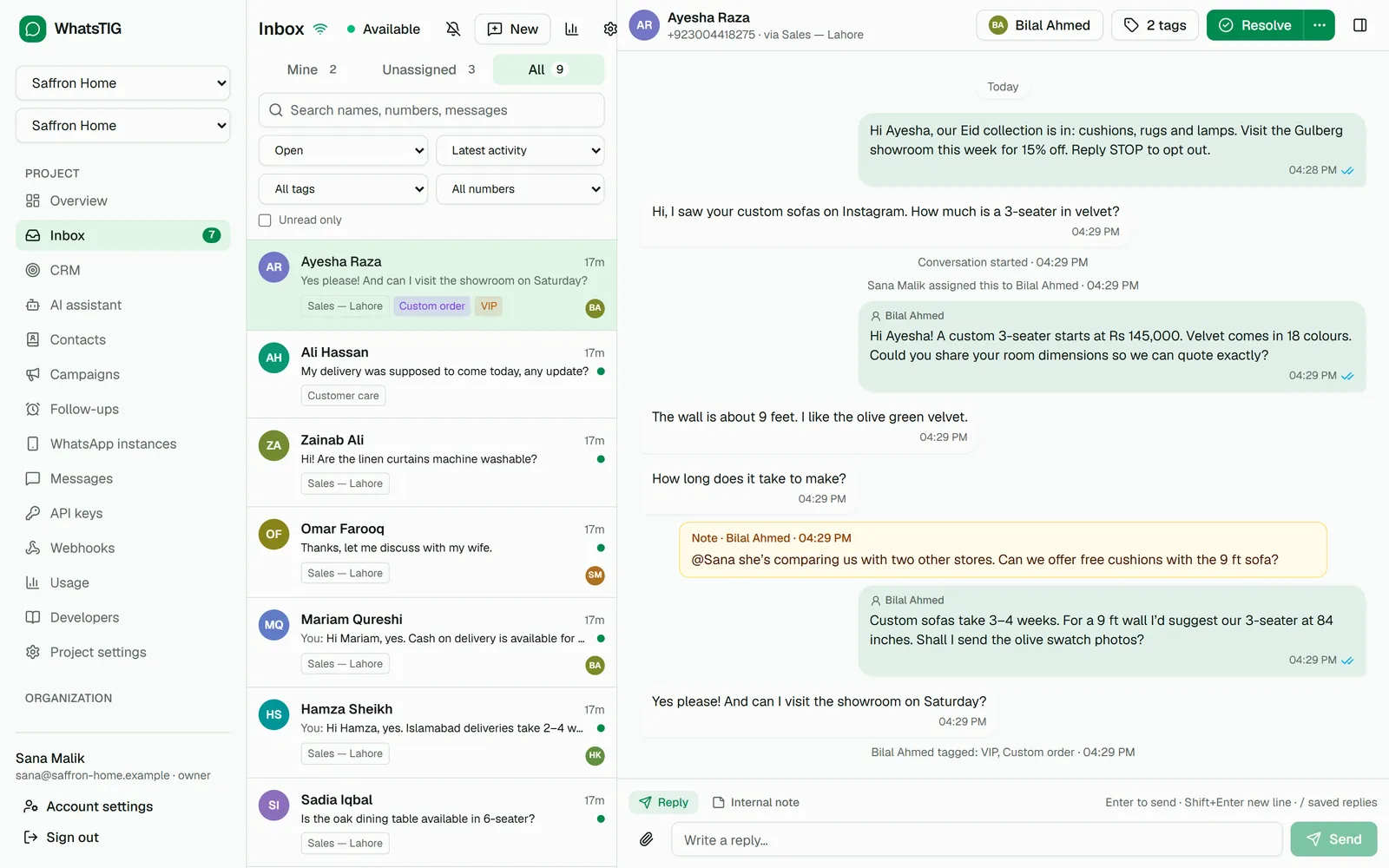
One linked number now serves six products: messaging API, team inbox, AI assistant, campaigns, CRM, and follow-ups. Each EduTig school messages parents from its own number, MailTig sequences gain WhatsApp steps that stop on reply, and any business or developer can start on a free plan.
A 202 means stored, not delivered. Telling developers the truth about every message is a feature, not a footnote.
What we studied before writing code
We did not start with a market thesis. We started with two of our own products that needed WhatsApp. EduTig, our school management software, sends attendance and fee alerts, and parents in Pakistan read WhatsApp far more reliably than email or an app notification. MailTig, our outreach workspace, had users asking for a short WhatsApp message on day three of an email sequence, sent from their own number, that stops the moment the prospect replies. Before building anything, we studied the official route, the alternatives, and what an integration inside a multi-tenant product has to guarantee.
The official WhatsApp Business Platform is operated by Meta. It asks for business verification, a dedicated number that is not also used in the WhatsApp app, pre-approved templates for messages a business starts outside a customer's 24-hour service window, and per-message fees by category and country on top of any provider's charges. Getting to a first message takes days to weeks. For a bank or a high-volume marketer, that is a reasonable price for an endorsed channel. For a school that wants to reach parents from the number they already have saved, or a small team that mostly answers questions, the friction and the variable cost arrive before any value does.
The integration requirements were specific. Each school or workspace keeps its own number and identity, so a parent sees the school's name, not a shared gateway. An administrator connects the number from inside our product, without creating another account or seeing an API key. Sends must be safe to retry, the product must know what was delivered instead of assuming it, and usage must reconcile against what each customer's package includes. Reminders also had to see replies in time: the fee reminders and outreach sequences our products scheduled on their own could not, and they did not respect the number's pacing.
We then reviewed the market by category: official-API inbox and CRM suites, hosted unofficial APIs with and without an inbox, and self-hosted open-source servers. Two gaps stood out. The multi-tenant story, a software product giving each of its customers their own number, was weak, and disclosure about the unofficial protocol was partial. Those two gaps, plus the cost and delay of the official route for small senders, defined the product.
- 01Specified the integrations of three RNDSOL products (EduTig, EduTig Enterprise, and MailTig) as the platform's first API consumers
- 02Compared the official Cloud API with the unofficial WhatsApp Web protocol on setup, templates, fees, restriction risk, and time to first message
- 03Reviewed competitors in four groups: hosted unofficial APIs, unofficial APIs with an inbox, self-hosted open source, and official-API inbox and CRM suites
- 04Mapped the questions buyers ask before connecting a number, from whether it is official to what an UNKNOWN status means
- 05Validated protocol behavior on real phones before every release that touches it, because WhatsApp behavior cannot be tested automatically
What customers were struggling with
The official route front-loads cost and delay
Business verification, a dedicated number, template approval for business-initiated messages, and per-message fees by category and country, all before a first message that can take days to weeks. After launch, every change of wording waits on a template review.
Customers trust the number they already know
Parents have the school's number saved; customers have the shop's. A message from a shared gateway number loses that identity, and a brand-new dedicated number has to earn it again.
Integrations that duplicate or overstate
A retried job sends a parent the same absence alert twice, or a dashboard shows a delivery tick the system cannot stand behind. Products need retry safety and a truthful answer to what was delivered.
One number, many people answering
When several staff answer the same WhatsApp number, nobody can see who is replying, customers get two answers or none, and there is no record of how long the first reply took.
Inquiries and follow-ups lost in chat history
Leads from ads, flyers, and forms arrive as chats with no source, owner, or next step. Reminders run from separate schedulers that cannot see a reply in time, so a nudge crosses an answer.
Fear of losing the number
WhatsApp restricts numbers that send unwanted messages, at any rate. Tools sold for bulk sending, or with tricks to dodge limits, put the one channel a business depends on at risk.
Where existing tools fall short
The calls we made, and what they cost
- 01
Build on the unofficial protocol, and disclose it everywhere
We chose Baileys, an unofficial implementation of the WhatsApp Web multi-device protocol, because it lets a business link the number it already has, with no verification, templates, or per-message fees from Meta. The cost is platform risk, and buyers and investors should weigh it: WhatsTig is not affiliated with, authorized, or endorsed by WhatsApp or Meta, accounts can be restricted, the protocol can change without notice, and delivery is never guaranteed. We contain that risk instead of hiding it. Baileys is pinned to an exact version and isolated behind one adapter; every routine upgrade is validated on real phones and runs on staging for at least 24 hours before rollout; and during a disruption, accepted messages wait in a durable queue instead of vanishing. A provider interface means an official Cloud API provider can be added without touching the rest of the platform. Every public page carries the disclosure.
- 02
Make consent and pacing product rules, not settings
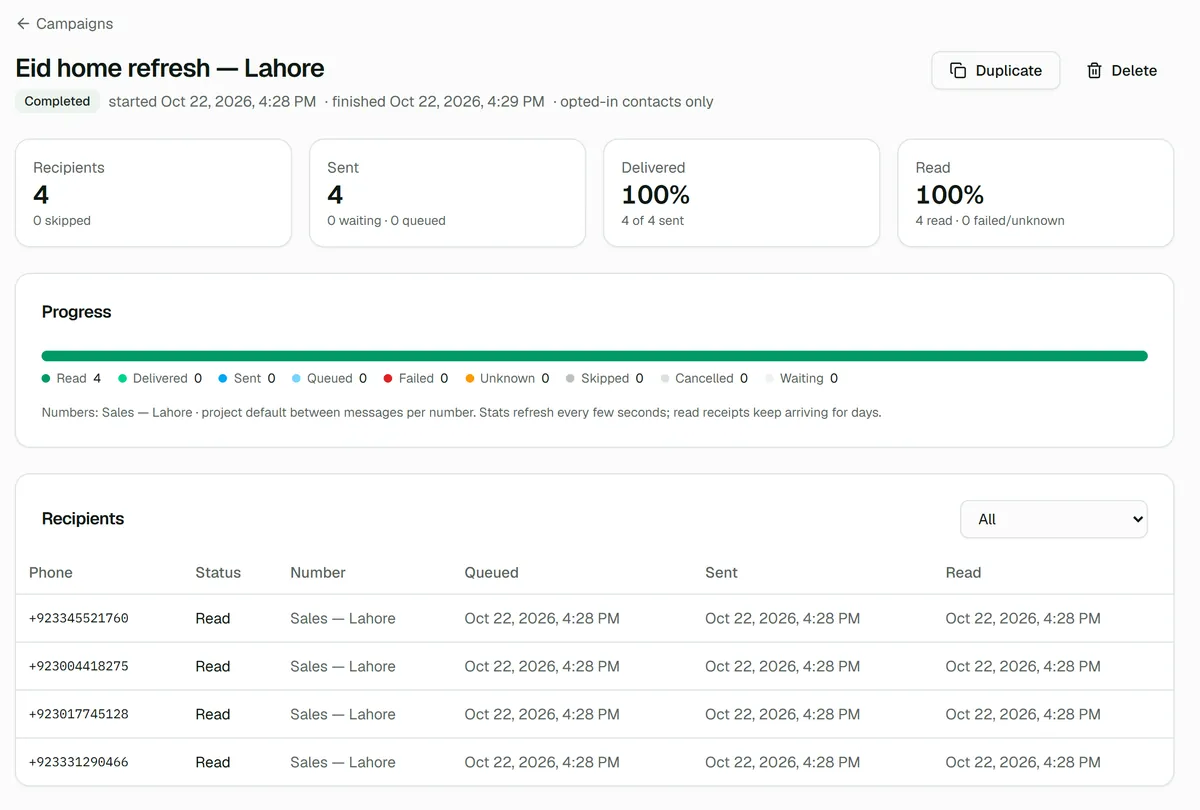
Campaigns message only contacts with a recorded opt-in by default, with proof of where, how, and when consent was given. Switching a project to opt-out mode is limited to owners and admins, requires a written justification, and is recorded in the audit log. STOP works on every number from day one, consent is checked again right before each message, and opt-outs survive imports and erasure. Each number keeps a deterministic pace (by default 3 seconds between campaign messages and 20 a minute) behind transactional traffic, with no randomized human-like delays, no number rotation, and no feature whose purpose is evading WhatsApp's limits. The trade-off is slower campaigns, and we accept it, because sending fast from one number is what gets numbers banned.
- 03
Tell the truth about delivery
Exactly-once delivery over WhatsApp is impossible: a crash between sending and recording leaves the outcome unknown. So a 202 means stored, not delivered; every send needs an idempotency key; each status records whether WhatsApp confirmed it or it was inferred; and an ambiguous send becomes UNKNOWN and is never retried automatically, while a later receipt can still upgrade it. Integrators have to handle UNKNOWN explicitly, which is more work for them, in exchange for never sending a parent the same alert twice.
- 04
Treat session reliability as the core of the product
Two workers holding one WhatsApp session corrupt it, so ownership uses database leases with fencing tokens, and a stale worker fences itself off. Session credentials are encrypted with AES-256-GCM using keys kept outside the database, so sessions survive restarts and deployments without a new scan, and a database dump alone cannot hijack them. PostgreSQL is both the source of truth and the message queue, so there are no dual writes and no lost or phantom messages. The costs: throughput is bounded by the database, which is ample for WhatsApp's per-account rates, and takeover after a crash takes one lease period, about 30 seconds.
- 05
Six products on one pipeline, multi-tenant from the start
The team inbox, AI assistant, campaigns, CRM, and follow-ups all run on the same message pipeline as the API, adding workers but no new infrastructure, so a guarantee made once holds everywhere. Organizations, projects, and externalReference let a software product give every customer its own number, and a partner API lets products like EduTig provision those customers automatically. One constraint we chose deliberately: a contact has at most one open lead, which keeps routing and reporting simple and moves parallel opportunities into deals.
From pain point to product
Start without verification or template approval
Link any WhatsApp or WhatsApp Business number by QR or pairing code; encrypted sessions survive restarts and deployments without a new scan.
Keep each customer's own number and identity
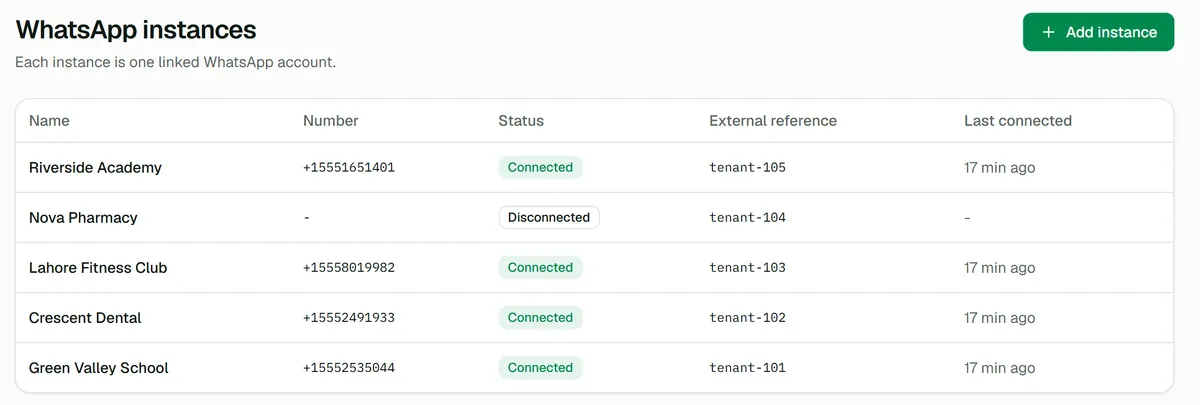
One instance per tenant mapped with externalReference, returned on every webhook, plus hosted connect links that need no WhatsTig account.
Retries that never duplicate, statuses you can trust
Required Idempotency-Key on sends, confirmed-or-inferred statuses, an UNKNOWN state, and HMAC-signed webhooks retried for about 16 hours with replay.
Many people answering one number
Team inbox with assignment, round-robin and least-busy routing, collision warnings, internal notes, saved replies, and response-time targets.
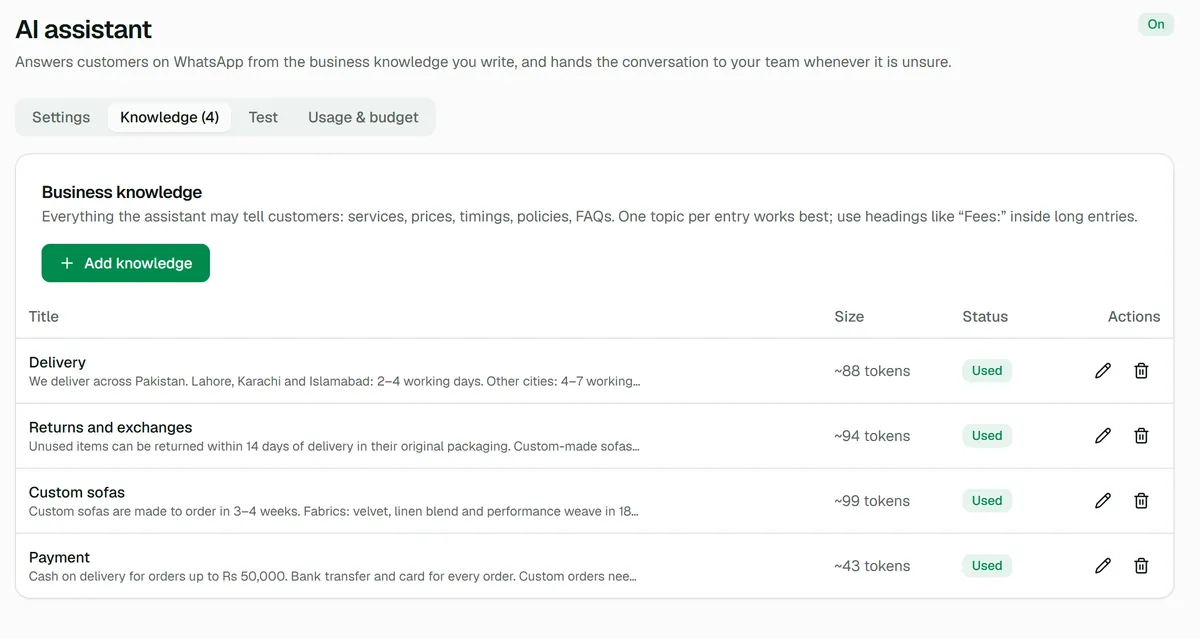
Instant answers without invented facts
AI assistant grounded only in the business's own knowledge, with a confidence threshold, handoff to a person, and a monthly budget reserved before every model call.
Messaging many people without risking the number
Consent-tracked contacts and campaigns: opt-in by default, STOP on every number, last-moment consent checks, per-number pacing, and automatic pauses.
Leads and follow-ups lost in chat history
CRM capture from chats, click-to-chat links with UTM attribution, and web forms; scoring, routing, and speed-to-lead targets; follow-up sequences that stop on reply.
Messaging included in a partner's own packages
A partner API that creates an organization per customer, grants the package's monthly messages, and signs users in with one click, as EduTig does.
Inside WhatsTig
How it makes money, and who it serves
WhatsTig sells flat monthly plans in US dollars, published in full on the product page: Free at $0 with one number and 1,000 messages a month, Starter at $19 for three numbers and 20,000 messages, Business at $99 for 25 numbers and 250,000 messages, and Enterprise on negotiated limits. Paid plans are billed monthly in advance, with invoicing for Enterprise agreements. There are no per-message fees from Meta in this model, which keeps costs predictable for small senders.
The free plan is the developer funnel. It includes the full API, webhooks, SDKs, and dashboard, so an integration can be built and tested before anyone pays. Paid tiers add the team features (inbox, AI assistant, campaigns, CRM, and follow-ups), which is where a business that started with notifications grows into daily use. Business is sized for software products serving many tenants.
AI is a separate, metered line: usage is billed by tokens against a monthly budget per organization, and each call is reserved before it is made, so the budget holds under any concurrency. Model costs stay visible and predictable instead of being buried in a flat price.
The partner channel extends distribution. A SaaS platform such as EduTig can include WhatsApp messages in its own packages: each of its customers gets a WhatsTig organization, the partner grants the monthly allowance through the partner API, and a customer who outgrows it can buy a WhatsTig plan on top. Every product that embeds WhatsTig brings its own customers with it.
We position WhatsTig for transactional and conversational messages to people who expect them, for teams that want to start today, and for software products with many tenants. We do not position it for unsolicited marketing or for regulated sectors where a restricted number would be an incident; for those, we recommend the official platform.
SaaS builders and developers
One instance per tenant, hosted connect links, idempotent sends, signed webhooks, an OpenAPI 3.1 contract, and TypeScript and .NET SDKs. Customers link their own numbers without a WhatsTig account, and the integration knows what was delivered.
Business owners
Start free with the number customers already know, pay flat prices in US dollars, and keep support, campaigns, leads, and follow-ups in one place instead of on one phone.
Support and sales teams
A shared inbox without double replies, an AI assistant that hands over when unsure, leads routed against a response target, and follow-ups that stop the moment a customer replies.
The people being messaged
Messages from a number they recognize, about things they asked for. STOP works on every number, and an opt-out holds until they opt back in.
Status today, and what comes next
WhatsTig is live at whatstig.com, with open sign-up on the free plan and published pricing. The public API is at version 1.4: five backwards-compatible releases in October 2026 added the team inbox and AI assistant (1.1), contacts and campaigns (1.2), the CRM (1.3), and follow-ups (1.4) to the 1.0 messaging core. Card billing followed.
It serves RNDSOL's own products in production: EduTig runs one instance per school, and MailTig mirrors the WhatsApp steps of its sequences into WhatsTig follow-ups. We do not publish customer counts, message volumes, or testimonials yet; when we do, they will be measured figures.
Not available yet: audio, video, location, contact, and interactive messages, group chats, automatic session rebalancing, moving a linked number between organizations, and a Python SDK (a Python integration guide exists). WhatsTig does not hold third-party certifications such as SOC 2 or ISO 27001.
Next on the roadmap
- Audio, video, location, and contact messages
- Interactive messages and group chats
- A Python SDK alongside TypeScript and .NET
- Automatic session rebalancing across workers
- Moving a linked number between organizations
- A dedicated guide for SaaS products: one instance per tenant, hosted connect links, and partner provisioning
- Real customer reviews, collected from EduTig and MailTig users before any are published
- TypeScript
- Node.js
- NestJS
- Fastify
- PostgreSQL
- Redis
- BullMQ
- Drizzle ORM
- Next.js
- Baileys
- OpenAPI 3.1
- Docker
See WhatsTig for yourself
WhatsTig is a WhatsApp API, team inbox, and CRM from RNDSOL in Lahore. Start free with one number and 1,000 messages a month; paid plans from $19.

Related reading
How to Avoid a WhatsApp Ban: Rules for Businesses
Message only people who opted in, honor STOP at once, send slowly, and keep content expected. No tool can guarantee that a number will never be banned.
WhatsApp Order Notifications for Small Businesses
How a small business sends WhatsApp order notifications: which messages to send, how to wire them to your store, safe retries, and the risks to weigh.
WhatsApp API for SaaS: One Number per Tenant
How to add WhatsApp to a multi-tenant SaaS product: one number per customer, hosted QR connect links, idempotent sends, and signed webhooks routed by tenant.
WhatsApp CRM in Pakistan: Leads and Follow-Ups
How businesses in Pakistan can turn WhatsApp inquiries into tracked leads: click-to-chat attribution, fast routing, follow-ups that stop on reply, and consent.
WhatsApp Business API Alternatives Compared
The official WhatsApp Business API, suites built on it, unofficial hosted APIs, and self-hosted servers: what each costs, what each risks, and how to choose.
How to Write a School WhatsApp Policy for Parents
What a school WhatsApp policy should cover: which messages go where, official numbers, reply hours, privacy rules, and what to automate. Template included.