 Product case studyFamily finance
MoneyTig: Building a Money Record for Pakistani Families
Pakistani households share costs without pooling their money, save through kameti and gold, and lend to relatives without paperwork. The budgeting apps we compared were built for a different household. This is how we designed MoneyTig for this one, and what we shipped.
- Finance scenarios specified
- 156
- Product decisions on record
- 18
- Tables under row-level security
- 149
- Automated API tests
- 573
The case in three lines
The problem
Household money in Pakistan is shared but rarely pooled. Rent and groceries are split while salaries and side income stay personal, and kameti turns, loans to relatives and gold sit in notebooks, spreadsheets and memory. The household apps we compared are built around full visibility for couples who pool their money.
Our approach
We built a double-entry record behind plain forms, with a private space for every adult, a shared space for the household, and access only by explicit grant. Kameti, family loans and gold are records in their own right, and a note typed in Roman Urdu becomes a draft that a person approves.
What it changes
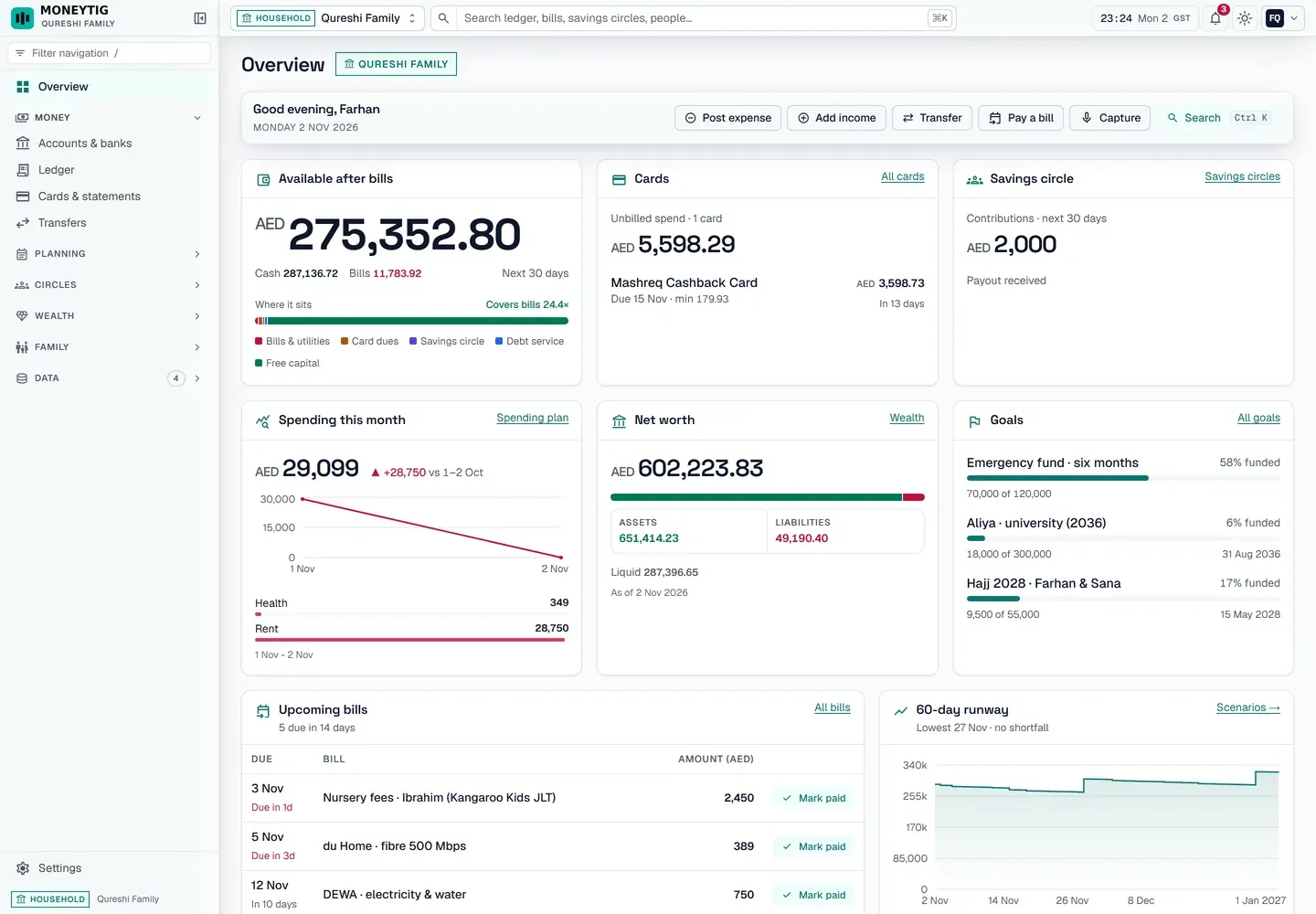
A record a family can share without exposing everything, where a kameti payout, a family loan and a gold valuation each mean what they mean, and an owner's business keeps separate books on the same platform. MoneyTig is live, with a free plan for personal records and paid plans for households and businesses.
Families share costs without pooling their money. MoneyTig is built to work the same way: private by default, shared by choice.
What we studied before writing code
We started by writing down how money moves in the households we were designing for, before deciding what the software should do. The result was a register of 156 family-finance scenarios across accounts, cards, loans, committees, shared costs, savings, assets, banking, planning, permissions, imports and recovery: 56 from our original product blueprint and 100 added in a second, extended research pass. Each scenario carries an acceptance condition. A cash withdrawal from the bank is a transfer, not a new expense. The same bank account entered by both partners resolves to one account. A pending bank payment that later posts is matched, not counted twice. Those conditions became the test plan: figures worked by hand before the code was written, which the software must reproduce.
We studied the household workbook, because that is where most families' existing records live. Household workbooks tend to share a shape: a tab per month with the year only in the file name, a planned column beside a paid column, rows marked paid with no amount, copied tabs such as "January (2)", committee sheets with placeholder dates from 1900, and totals sitting among the transactions. Each of these became an explicit case in our import path instead of a silent guess, because a migration that guesses invents history.
We studied how people describe money when they type it. In Pakistan that is often Roman Urdu mixed with English: "5000 groceries kal cash se", with kal for yesterday, tankhwah for salary, qist for an installment, kiraya for rent, JazzCash or Easypaisa for the account, and amounts in lakh and crore. A capture tool that reads only English, or that fills gaps with guesses, would misrecord the everyday case.
To test our positioning, we compared the household access models that Monarch, YNAB and Wallet by BudgetBakers document, and noted Splitwise and Lunch Money, which solve narrower jobs. The documented models suit couples who pool everything, or give a manager access to members' plans. Where selective sharing exists, it is per account. None of them documented the combination we needed: scope by space and by account, an expiry, an amount limit, an explicit deny that wins, and a preview of the recipient's view before access is granted.
- 01A register of 156 family-finance scenarios, each with an acceptance condition
- 02Analysis of household workbooks: monthly tabs, planned and paid columns, committee sheets and asset snapshots
- 03Roman Urdu and English note patterns for amounts, dates, accounts and categories
- 04A dated comparison of the access models Monarch, YNAB and Wallet document, with Splitwise and Lunch Money noted
- 05Hand-worked household and business figures, written before the code and replayed as automated tests
- 06A year of invented showcase data for households in three currencies and two businesses, walked page by page as each person
What customers were struggling with
Shared costs, private money
Rent, utilities and the monthly ration are split; salaries, side income, savings and a loan to a sibling are not. A shared spreadsheet or a couples app forces a choice between showing everyone everything and tracking nothing together.
Kameti records that distort the month
A committee is a series of fixed contributions and one payout turn, sometimes less an organizer's fee or a shortfall. Written down as ordinary spending and income, the contributions make every month before the payout look expensive and the payout month look like a windfall.
Loans between relatives that live in memory
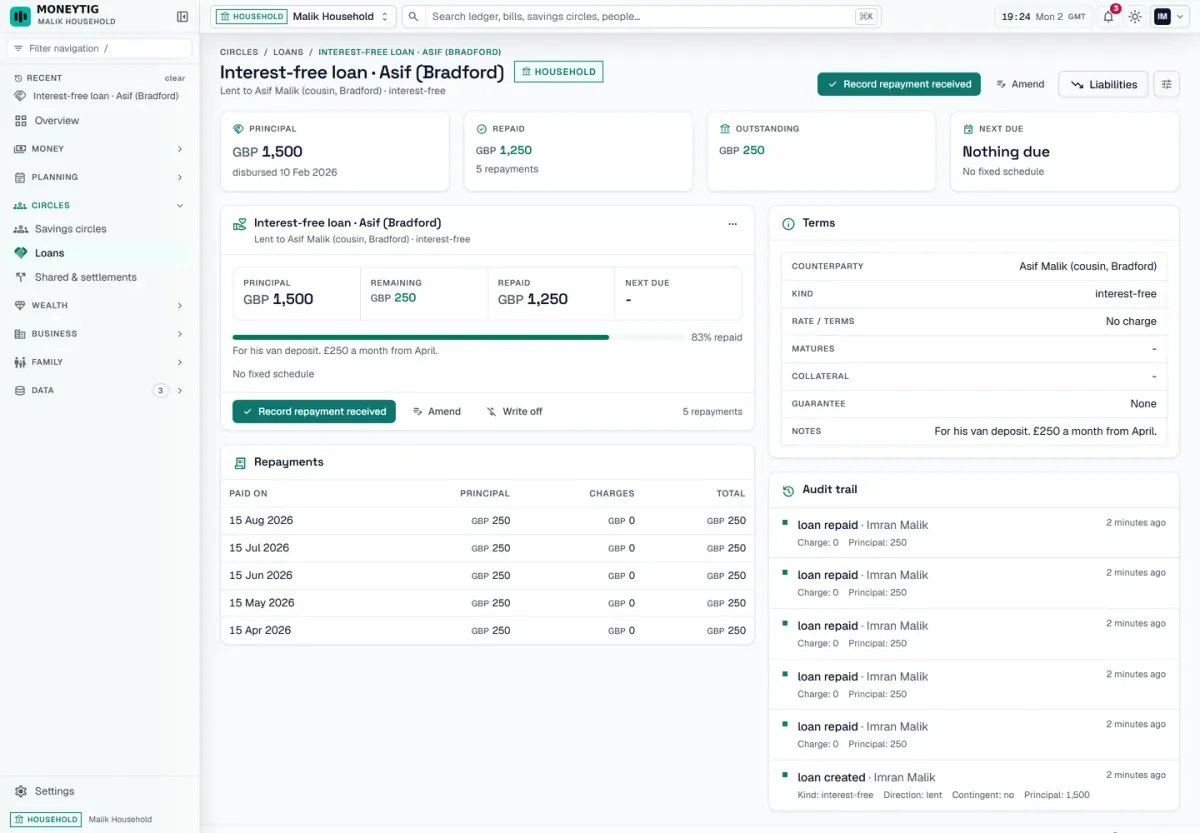
Money lent to a cousin or borrowed from a parent is often interest-free, repaid on no fixed schedule and tracked, if at all, alongside everyday spending. The month it was lent looks like a bad month, and every repayment looks like income.
Wealth held in gold and property, valued once
Much of a family's savings is gold weighed in tola and a plot or a house. A single figure typed once goes stale, and a total that mixes old valuations or adds different currencies claims more certainty than anyone has.
Forms in a language nobody types in
People describe money in Roman Urdu mixed with English, with lakh and crore and day words like kal. Apps that expect a structured English form turn a five-second note into a chore, so the record stops being kept.
The business and the home in one pocket
In an owner-run business, takings pay household bills and household savings cover a slow month. With one pocket, the owner cannot say whether the business earns money or the family is funding it.
Where existing tools fall short
The calls we made, and what they cost
- 01
Record money, never hold it
MoneyTig writes down what happened. It does not hold funds, move money, initiate payments or run a money pool, and no bank, card or payment provider is connected. That gives up automatic bank sync and in-app settlement. In return, MoneyTig never sits between a family and its money, and a kameti stays what it is: a private arrangement between people, with MoneyTig keeping the record. The cost is that every balance is what someone entered, imported or pasted from a statement, so every figure is labeled as recorded or statement-verified, with the date it is as of.
- 02
Spaces and grants, not relationships
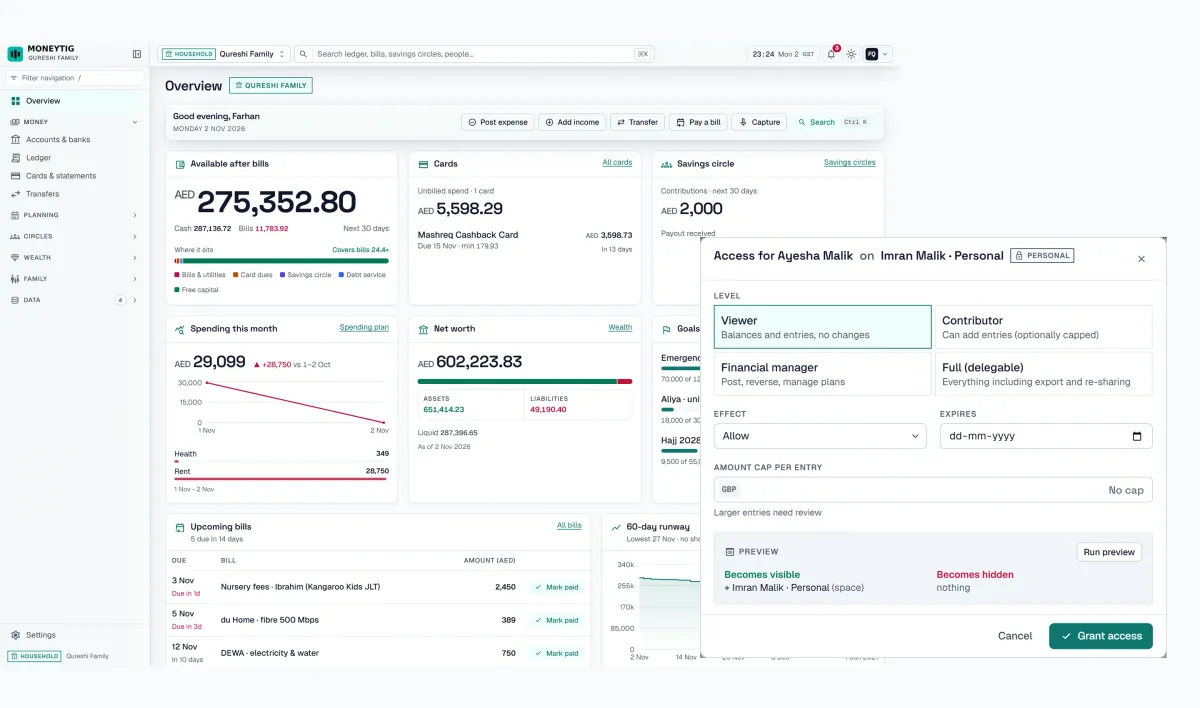
Every record belongs to one space: personal, household, purpose or business. A role name is a label, and a relationship on the family map grants nothing; access comes only from grants, which name actions and can carry an amount limit, an expiry or an explicit deny that wins. The database enforces the same boundary with row-level security on every table. The cost is setup, because someone has to decide and grant. We reduced it with a preview of exactly what a member will see before the grant applies, and revocation that takes effect on their next request.
- 03
AI drafts, people post
Capture turns a typed note into draft entries, and nothing posts without a person's approval; automatic posting is disabled in this release. The model's answer is kept only where the note supports it: an amount must appear as digits, the space is always the one the person chose, and instructions about access written inside a note are ignored. Without consent, MoneyTig's own rules read the note and nothing leaves our servers; with consent, account, card and phone numbers and email addresses are masked first. The trade-off is one more tap per entry, which we accept because a wrong figure posted silently costs more to find than a draft costs to approve.
- 04
One platform, separate books for home and business
A household and an owner-run business use the same double-entry engine, the same grants and the same row-level security. Business records belong to the legal entity, never to a person or a family, and each entity has exactly one live book in its own space. We rejected keeping a book inside a household space, because that puts a family's money and a business's in one boundary. The business core is accrual, with a cash view derived from it rather than kept as a second ledger. The model is stricter than many small-business tools; it gives an owner two clear pictures instead of one blurred one.
- 05
Pakistan first, and refuse rather than guess
We chose Pakistani individuals, families and owner-operated service businesses as the first market, with rupees, lakh and crore and Roman Urdu as defaults, and rejected a multi-market first release that would multiply the tax and jurisdiction questions before the first market was served well. Defaults are not limits: a space can keep its books in any of 34 currencies. Where the software lacks a fact, it refuses: with no recorded exchange rate a foreign entry is refused and a total says it is incomplete, and a missing tax rate is a refusal, never a zero.
From pain point to product
Share household costs without sharing every account
Personal, household and purpose spaces; an access matrix with grants, limits, expiry and deny; a preview before applying; revocation on the member's next request.
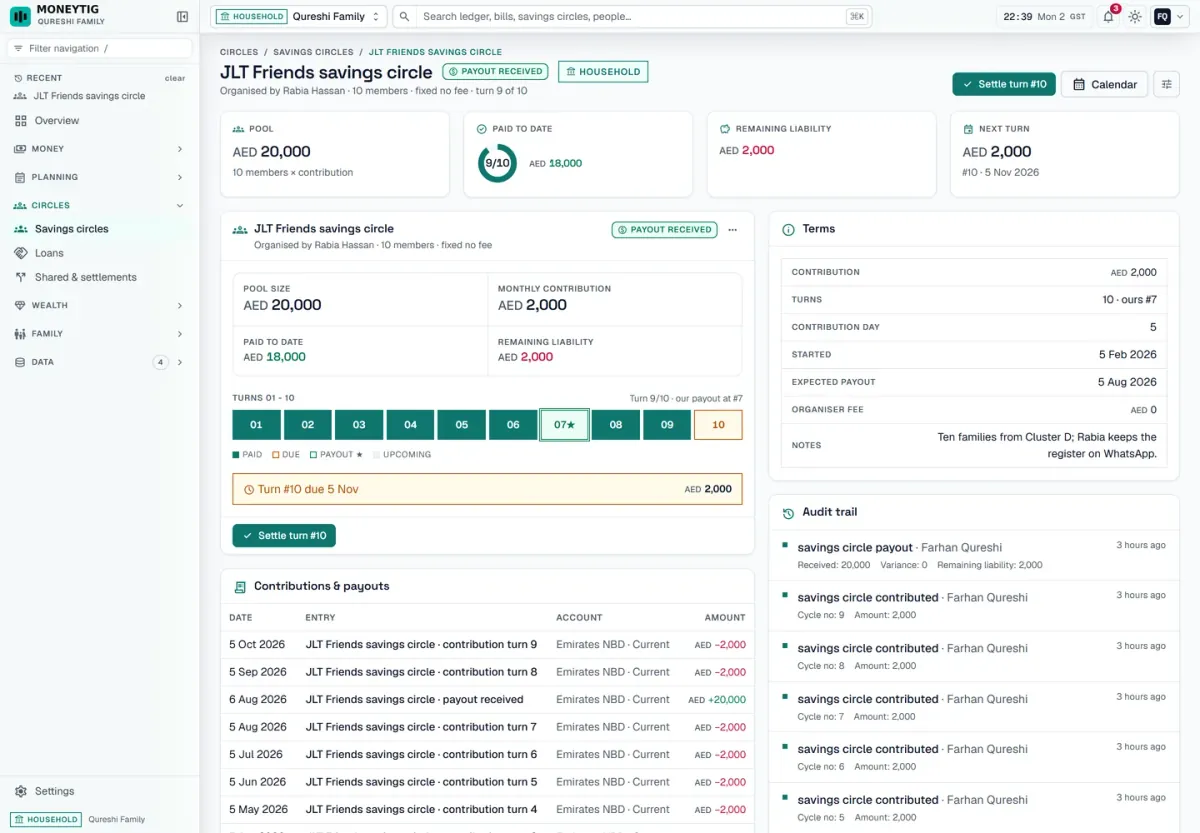
Keep a kameti on the record
Committee records with a turn matrix, contributions and your payout turn. Contributions sit as a receivable before the payout and a liability after it, and any difference is posted as a fee, shortfall or surplus.
Track loans between relatives
Loans lent or borrowed, to a member or a contact, across nine kinds including interest-free qarz, with schedules, repayments, guarantees shown as contingent exposure, and reschedules that must equal what is owed.
Value gold and property with dates
Assets with dated valuations and their source, ownership shares, gold by tola, gram or ounce with purity, and a net worth that lists unconverted items and says when it is incomplete.
Know what is left after the bills
Bills and schedules across 12 types, three budget methods, a financial calendar, a cash runway with what-if scenarios, and a figure for the cash left once the next thirty days of recorded bills are reserved.
Record money the way people say it
Capture of Roman Urdu or English notes into drafts with duplicate and missing-field checks, reviewed in a capture inbox, plus an Android companion in pre-release that queues entries offline and sends each one once.
Bring years of spreadsheets across
Workbook import from pasted rows with formulas kept as text, an exception queue, commit and roll back, and bank statements pasted and matched by hand.
Run the business apart from the home
Business books on the web: invoices, receipts, quotes, supplier bills with approval rules, fiscal periods with checksummed close snapshots, five financial statements including a derived cash basis, and read-only accountant access.
Inside MoneyTig
How it makes money, and who it serves
MoneyTig is priced per account, per month, in USD, and the terms are published on moneytig.com: a free Personal plan, Family at $4.99 with a household space, Business at $9.99 with one business book, and Complete at $14.99 with both. Each paid plan is set to start with 10 days free and no card.
The structure follows the product's shape. One person's own records are free, so a family can start without a purchase decision; the paid plans add what a household or a business needs beyond that. Paying never grants access: a plan governs what an account may add, never who may read what, and a downgrade removes nothing already recorded. A person's export of their own personal space is never held back by a plan.
We position MoneyTig between a budgeting app and accounting software: deeper than a budget on obligations, loans, committees and wealth, held together by double-entry, without asking a household to learn accounting. Pakistan is the first market, and the product is built to travel, with 34 currencies and any time zone chosen at sign-up.
The adult who runs the household's money
One place for bills, budgets, kameti turns and family loans, with the authority to decide who sees what and a preview before any access goes out.
Other family members
A private space that nobody reaches by being family, a household view of what they owe and what has been settled, and access that can be limited or set to expire.
Owner-operators
Business books apart from household money, with owner funding recorded as funding, invoices and supplier bills tracked to payment, and financial statements for each period.
Accountants and advisers
Read-only access to a business book for a stated purpose and period, visible to everyone on the book, and an audit trail of every change.
Status today, and what comes next
MoneyTig is live at moneytig.com. A person can sign up, start on the free Personal plan, and add a household space or a business book on a paid plan with 10 days free. It runs in any browser in English or Urdu, in any of 34 currencies.
The household product covers the full design: spaces and grants, accounts and the ledger, cards, bills and budgets, kameti and committees, family loans, shared costs, wealth, imports, reconciliation, AI capture, exports, and the audit trail. Owner-run service businesses keep their own double-entry books on the web, and the Android companion is available as a pre-release that records entries offline.
Quality is measured, not asserted: 573 API tests against a PostgreSQL database, 139 browser tests, and 121 tests for the phone app, with every figure in the 156-scenario register worked by hand before the code was written and replayed automatically on every change.
Next on the roadmap
- A signed Android build in the Play Store, then the iOS companion app
- Receipt-photo scanning and push notifications
- Off-site backups with restore drills run from the off-site copy
- A qualified accountant's review of the business chart of accounts and treatments
- E-invoice submission, only where a jurisdiction review has verified it
- TypeScript
- Next.js 15
- NestJS 11
- PostgreSQL with row-level security
- Drizzle ORM
- Flutter
- Groq (AI capture)
- Playwright
- Tailwind CSS 4
See MoneyTig for yourself
MoneyTig is a family budget app for Pakistan: kameti, family loans, bills and gold on one record, with private spaces, shared access, and a free plan.

Related reading
Monthly Household Budget in Pakistan: A Worked Plan
Budget fixed costs first, average summer electricity over the year, and fund zakat, Eid and weddings monthly. A worked rupee example for Pakistani homes.
How to Track a Kameti (Committee) Properly
A kameti is easy to join and hard to track. How to record contributions, the payout and any fee so your records stay right before and after your turn.
How to Share Household Costs in a Joint Family
In a joint family, money is shared but rarely pooled. How to split bills, record who paid and settle up monthly without exposing anyone's own accounts.
How to Keep Business and Household Money Apart
When a business's takings pay the home's bills, nobody knows what the business earns. How owner-operators separate the two and name the money that crosses.